
Home / ModernPerfumery
Ozone Perfume Notes

Ozone Perfume Notes: Airy, Aquatic and Clean

Ozone perfume is a modern fragrance category created to evoke the crisp, clean, and slightly electric scent of air after a thunderstorm, sea spray, or freshly laundered linen. These scents are typically synthetic, using ozonic notes to recreate metallic, aquatic, or mineral nuances. Popular in both unisex and niche perfumes, they offer an airy, refreshing, and subtly metallic character.

Ozone perfume notes create a kind of clarity that feels clean without being soapy or sharp. An ozone perfume tends to feel open and light, as if there is more space around the scent. Some perfumes do not immediately remind you of flowers or fruit. Instead, they bring to mind a feeling. It might be the stillness after rain or that faint coolness in the air before a storm breaks. That sensation often comes from ozone.

Over time, ozone has found its place in modern fragrance, especially in styles that lean towards freshness rather than warmth. It offers something different. Not sweetness, not richness, but air.

What Does Ozone Smell Like?

It is not easy to describe ozone in simple terms. People often reach for comparisons rather than direct descriptions. The scent can feel slightly metallic, sometimes watery, and often crisp.

You might notice it most:

  • Just before the rain starts to fall
  • In the air after a thunderstorm
  • Near the sea, when the breeze carries a clean edge

There is a certain sharpness, though not in an unpleasant way. It feels more like a cool sensation than a strong smell. Unlike citrus or vanilla, ozone does not sit heavily on the skin.

Because of this, it works well in a unisex fragrance. It does not lean too soft or too bold. It simply adds a sense of fresh air, something that feels neutral but still interesting.

Fragrance Description Magnolias Bloom Ozone Melon Violet Rosewood

Where Ozone Comes From in Perfumery

Ozone is not derived from natural ingredients in the way that an essential oil would be. It is created using synthetic aroma materials designed to suggest the feeling of air and water.

This approach became more common as perfumery evolved. Rather than relying only on essential oils, perfumers began using fragrance oils and molecules to build entirely new scent effects.

One of the key materials behind ozone is calone. It introduced a marine quality that felt new at the time, slightly watery with a touch of fruity freshness. It played a large role in shaping aquatic fragrance as we know it today.

Aldehydes are often used alongside it. They bring brightness and lift, helping the fragrance feel lighter and more diffused.

Even so, ozone rarely stands alone. It is usually blended with natural ingredients such as citrus or soft florals. Bergamot is a common addition, as are white flowers like jasmine. These combinations help create a balanced fragrance that feels complete rather than abstract.

How Ozone Changes a Perfume’s Character

A small amount of ozone can shift a perfume quite noticeably. Without it, a fragrance may feel dense or close. With it, the whole composition seems to open up.

It is often paired with:

  • Citrus notes to add brightness
  • Marine accords for a watery effect
  • Woods for structure
  • Florals to soften the edges

What ozone does best is create space. It allows the different parts of a perfume to settle into a more harmonious blend.

This is one reason it works well in a versatile scent. It adapts easily and does not overwhelm, which makes it suitable for many occasions.

Pairfum Flacon Room Perfume Spray Sea Beach 1 1

Ozone in Iconic Clean and Aquatic Perfumes

When ozone first appeared in perfume, it felt quite different from what people were used to. Earlier styles often focused on powdery or rich compositions. Ozone introduced something lighter.

Aquatic perfume grew quickly from that shift. These fragrances focused less on traditional notes and more on the idea of water, air, and movement.

Today, ozone appears in both eau de toilette and eau de parfum. The difference usually comes down to strength. An eau de parfum, with its higher concentration, tends to last longer and develop more fully on the skin.

Some perfumes aim for a signature ozone perfume style. The intention is not to stand out loudly, but to leave a clean and subtle trace.

Why Ozone is Perfect for Cold Weather Freshness

During colder months, many people turn to a heavier perfume. Yet ozone offers an alternative that feels just as appropriate.

Cool air tends to sharpen fresh notes. This means ozone can feel even clearer in winter, especially after rain, when the air already carries that crisp quality.

It also avoids excess. There is usually less emphasis on musk or vanilla, which keeps the fragrance from becoming too dense.

For those who prefer something understated, ozone perfume can feel like a natural choice for daily wear in colder weather.

How to Wear Ozone Perfume

There is no strict way to wear ozone perfume, but a few small details can make it more effective.

Applying a light spray to moisturised skin helps the fragrance settle more evenly. Dry skin can cause the scent to fade more quickly, which affects the overall lasting scent experience.

Body chemistry also plays a role. The same perfume may feel sharper on one person and softer on another. It is always worth testing how it develops on your own skin type.

A few simple suggestions:

  • Apply to pulse points such as the wrists or neck
  • Avoid rubbing the fragrance after applying
  • Store your perfume away from direct sunlight

These small habits can help maintain an enduring scent and support a more consistent, lasting fragrance.
Aquatic Ozone Perfume

Ozone and Modern Scent Profiles

Ozone is often used to lighten more complex compositions. In a chypre fruity scent profile, for example, it can reduce the sense of heaviness and introduce a fresher edge.

It also works well with citrus, florals, and woods, creating a harmonious blend that feels current without being unusual.

Because it diffuses gently, ozone contributes to a lasting fragrance that remains noticeable without becoming overpowering. This balance adds to the sense of sophistication often associated with modern perfume.

The Science Behind Ozone in Fragrance

In nature, ozone forms during electrical activity in the atmosphere, which is why people associate it with storms and rain.

Perfumery does not recreate ozone directly. Instead, it builds an impression using carefully selected molecules. The result is not an exact copy, but something that captures the same feeling.

This reflects a broader shift in fragrance, where the focus is not always on replicating a material but on evoking an experience. It is a good example of how innovation continues to shape the industry.

Fresh, Light, and Always Modern Ozone Notes with Pairfum London

Ozone does not aim to be traditionally rich or sweet. It sits apart from notes like vanilla or heavier musk, offering something quieter.

That is part of its appeal. It creates space rather than filling it.

A signature ozone perfume often feels subtle, yet it leaves a lasting impression. It suits a wide range of occasions and works well as a daily wear option.

Magnolias in Bloom – Flacon Perfume Room Spray by Pairfum London

A delicate spring floral accord opens with a fresh touch of ozone, soft white flower petals, and a subtle hint of watery melon. At its heart, a layered bouquet unfolds with magnolia, lily, geranium, rose, and violet, before settling into a smooth base of musk and rosewood.

Pairfum Flacon Perfume Room Spray Signature Magnolias In Bloom

Final Thoughts

Ozone captures something difficult to define but easy to recognise. It brings to mind fresh air, rain, and open space without relying on obvious notes.

As a fragrance style, it remains relevant because it offers balance. It is clean without being empty and present without being overwhelming.

If you want to explore further, you can read more about how ozone interacts with other notes. A quick look at our other fragrances and their product details may also help you understand how different compositions are structured.

In the end, ozone continues to hold its place in modern perfume. It is quiet, clear, and understated, which is precisely why it works.
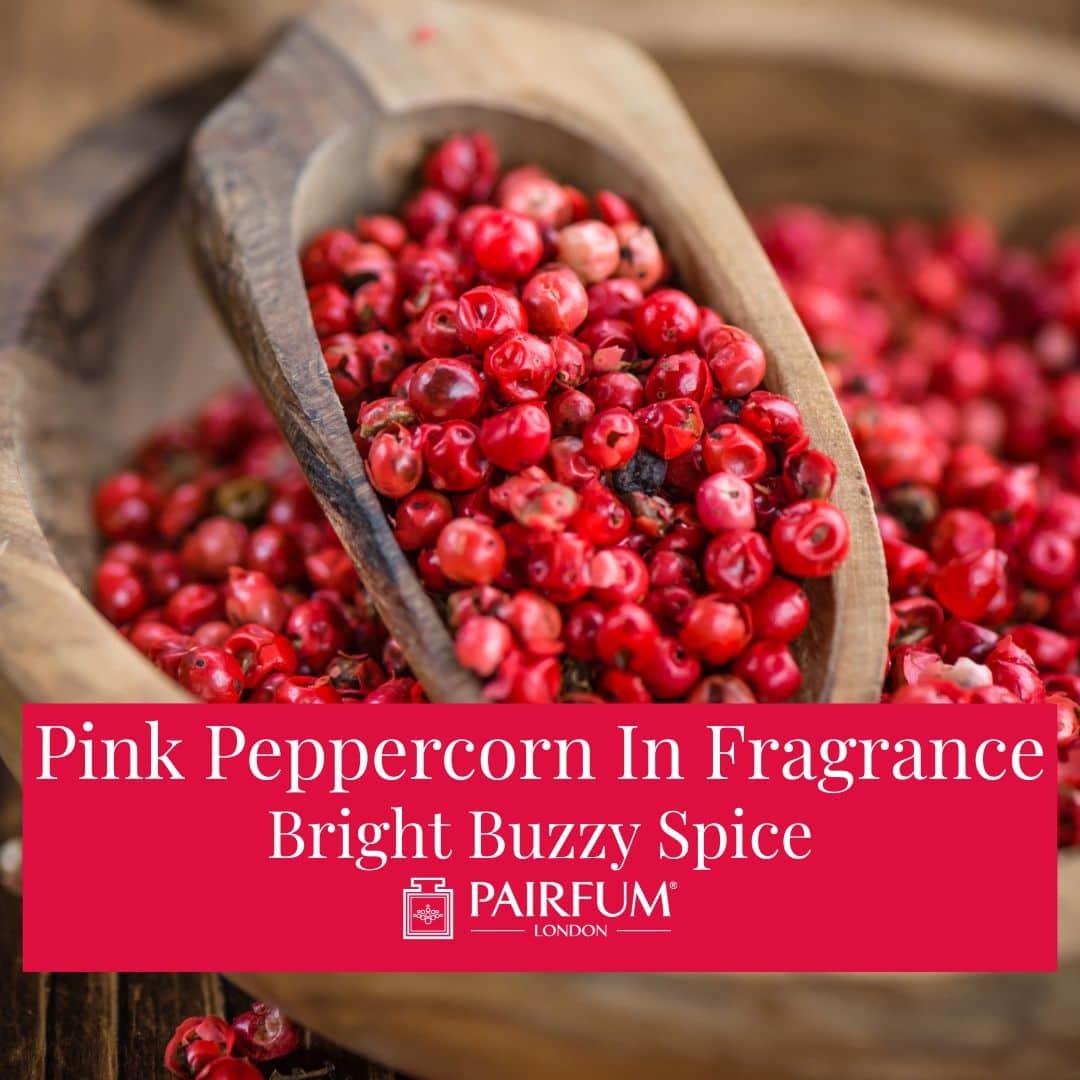
Pink Peppercorn In Fragrance

Pink Peppercorn In Fragrance: Bright Buzzy Spice

Pink peppercorns are the dried, sweet, and mildly spicy berries of the Peruvian pepper tree or Brazilian pepper tree, rather than true peppercorns. They offer a fruity, slightly citrus note to dishes such as fish, salads, sauces, and even desserts or cocktails, and are valued for their vibrant colour and delicate flavour. Pink peppercorns belong to the cashew family and are most often used as a garnish or light seasoning, adding a distinctive aroma and gentle warmth rather than sharp heat.

Pink Peppercorn is the sort of ingredient that catches you off guard in perfume. Light, fizzy, and just a little spicy, it adds a cheerful spark that lifts everything around it. You will often find it playing a key role in modern floral or woody fragrances, giving them a bright edge that feels fresh but still carries warmth. That makes it a perfect fit for early winter, when we are craving comfort and sparkle at the same time.

It is easy to mix up Pink Peppercorn with black pepper, especially when scanning a fragrance listing. But where black pepper is sharp and dry, pink peppercorn is sweeter, softer, and surprisingly fruity. It has a champagne-like pop that works in both classic and unconventional blends.

There is a quiet confidence to this note, never overpowering, just the right kind of zing. Let us look at where it comes from, how perfumers work with it, and which creations have used it particularly well.

A Little History of Pink Peppercorn

Despite its name, Pink Peppercorn is not a true peppercorn at all. It is the dried berry from the Schinus tree, often called the Peruvian pepper tree, found in parts of South America. The fruit has a rosy colour and mild peppery flavour, which is how it ended up in kitchens long before perfumery.

More specifically, pink peppercorns come from two closely related plants: the Peruvian pepper tree, also known as Schinus molle, and the Brazilian pepper tree, or Schinus terebinthifolius. These trees are sometimes collectively referred to as the Peruvian peppertree, and they are part of a different plant family from true pepper.

This distinction matters. True peppercorns, including black peppercorns, white pepper, and white peppercorns, all come from the same vine and are considered real peppercorns. Pink peppercorns, by contrast, come from a different plant entirely, even though they resemble a regular peppercorn once dried.

  • Unlike spices like clove or cinnamon with ancient histories in fragrance, Pink Peppercorn is a relatively new addition.
  • It gained popularity among modern perfume houses over the past few decades, particularly as preferences shifted toward lighter, more playful scents.
  • Its slightly fruity, gently spicy character made it easy to include in blends across seasons.

The berries themselves start as small green fruit before turning pink as they ripen. These ripe berries are harvested, dried, and transformed into the familiar pink peppercorn. In culinary contexts, they are sometimes called pink berry or baies rose.

It does not have the weight of more established spices, but that is exactly what makes it helpful in adding a clean but shiny feel to a perfume.

Fragrance Description Pink Powder Violet Rose Iris Orris

How It’s Sourced and Extracted for Perfume

Pink peppercorns grow in clusters on the pepper tree, thriving in warm climates across South America. Both the Peruvian pepper and Brazilian pepper varieties produce generous crops of fruit. These ripe berries are typically picked by hand to protect the delicate berry skins.

Once harvested, the fruit is dried. Each dried berry becomes a peppercorn with a vibrant colour and distinctive flavour. In perfumery, extraction focuses on preserving that freshness.

  • Rather than steam distillation, Pink Peppercorn oil is often obtained through CO2 extraction.
  • This process captures the fruity, citrus facets without introducing bitterness.
  • The result is a naturally bright and zesty perfume ingredient with complex layers.

Unlike black pepper or green peppercorns, which can feel sharp and dry, pink peppercorns feel light and buoyant. This makes them ideal for top or heart notes, where lift and movement are needed rather than depth alone.

Pink Peppercorn, True Pepper, and Common Confusions

Because of its name and appearance, pink peppercorn is often confused with true peppercorns. However, it is not a true pepper at all. True peppercorns come from the pepper vine and include black pepper, white pepper, and green peppercorns.

Pink peppercorns belong to a different plant family. They are closer relatives of plants such as poison ivy, which explains why some people may experience sensitivity when handling large amounts of the raw fruit. In fragrance use, this is not a concern, as the material is highly refined and used sparingly.

Pink peppercorns are also sometimes compared with chilli peppers, but this is another misconception. Chilli peppers deliver heat. Pink peppercorn delivers aroma, sweetness, and a mild peppery flavour without spice burn.

Safety Considerations Around Pink Peppercorn

Pink peppercorns are generally safe when used in small quantities, but they are not suitable for everyone. Because the pepper tree is related to plants such as poison ivy, some individuals may experience allergic reactions when handling or consuming pink peppercorns.

This sensitivity is rare, but it is documented. As a result, pink peppercorns are often labelled separately from true peppercorns in food settings. In fragrance, the extraction process removes proteins that typically cause irritation, making the ingredient safe for use in perfumes under regulated standards.

These distinctions are one reason pink peppercorn is treated differently from true pepper in both kitchens and perfumery.

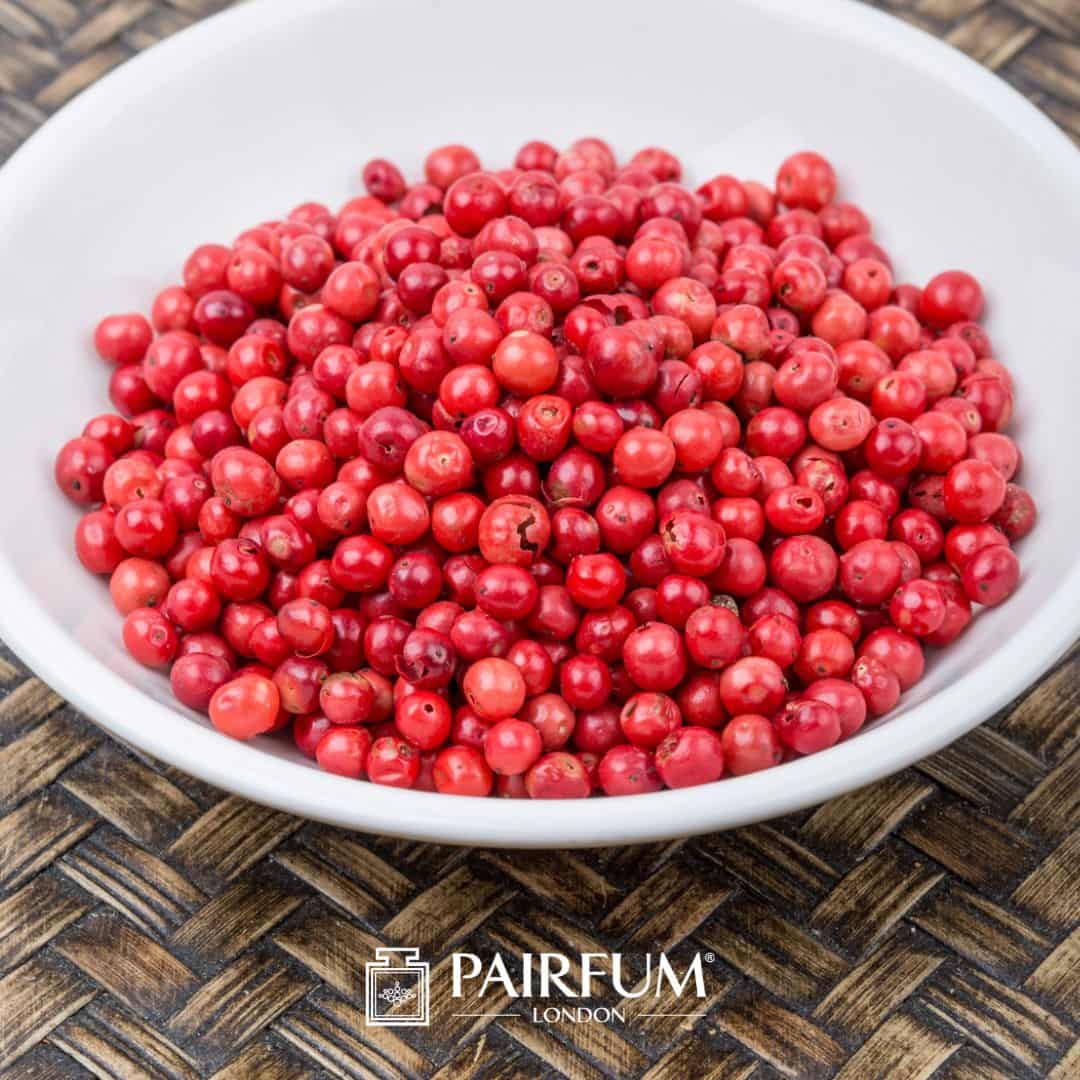
Pink Peppercorn In A Bowl

Culinary Associations and Everyday Uses

Outside perfumery, pink peppercorns are used mainly for their colour and gentle flavour. They often appear sprinkled over a salad, folded into butter, or used as a decorative element in sauces. A mixed pepper mill may include pink peppercorns alongside black peppercorns, white peppercorns, and green peppercorns.

In cooking, pink peppercorns are rarely used alone. They are usually part of a spice blend designed to add visual appeal rather than heat. Their flavour pairs well with vegetables, light fish dishes, and creamy sauces, where stronger pepper would overwhelm the dish.

Because pink peppercorn is not a regular peppercorn, chefs tend to treat it carefully. It adds sweetness and fruit rather than sharp spice, which mirrors how perfumers use it in fragrance.

What It Brings to Perfume Blends

Pink Peppercorn works a little like a squeeze of citrus in cooking. It does not necessarily take centre stage, but it changes everything around it. It adds movement, clarity, and edge.

  • In woody blends, it cuts through thick, earthy tones to add contrast and sparkle.
  • With florals like rose, peony, or jasmine, it can sharpen the softness and add dimension.
  • When paired with musks and ambers, it keeps the warmth feeling airy rather than heavy.

It is especially helpful in perfumes that want to feel youthful but not simple, polished but never sweet. There is a dry quality to it that avoids sugariness, even when used alongside fruit or flower notes.

That is why Pink Peppercorn really shines in winter perfumes, trying to bring lightness into colder months. It creates a bright opening that still fits with the deeper, cosier base that winter-heavy perfumes often lean into.

Pink Peppercorn also brings a feeling of sparkle and freshness to a composition that might otherwise feel a bit too serious or heavy. While it is subtle, it can make a fragrance seem more lively and energetic, perfect for days when you want your scent to add a little extra to your mood. This is why it is often chosen for perfumes aiming to thread the line between comfortable and upbeat, working equally well in daytime or evening wear. Its brightness bridges the gap between cooling citrus notes and deeper spices or woods, helping each layer unfold smoothly on the skin.

Pairfum Fragrance Candle Flacon Room Perfume Spray Bathroom Spa 1 1

Pink Peppercorn Compared to Other Pepper Notes

When set beside black pepper, pink peppercorn feels rounder and more fragrant. Black peppercorn delivers sharp spice, while white peppercorns can feel dusty and intense. Pink peppercorns sit apart, offering a balance of spice, sweetness, and fruit.

Green peppercorns bring a fresh, vegetal edge, but they lack the brightness of pink peppercorns. Red peppercorns is a name sometimes used interchangeably with pink peppercorns, referring mainly to their colour rather than flavour.

This contrast explains why perfumers choose pink peppercorn when they want spice without aggression.

How Pink Peppercorn Differs From Other Peppercorns

True peppercorns all come from the same plant species and differ mainly by processing. Black peppercorn is dried while still green, white peppercorns are fermented and peeled, and green peppercorns are preserved before drying.

Pink peppercorn does not follow this process. It is harvested from a different plant and dried whole, retaining its berry-like structure. This is why it lacks the sharp bite found in true peppercorns.

Understanding this difference helps explain why pink peppercorn behaves differently in both cooking and fragrance. It contributes aroma and nuance rather than intensity.

Iconic Fragrances That Feature Pink Peppercorn

You are more likely to find Pink Peppercorn in niche perfumes, where perfume creators lean into ingredients that feel interesting and modern. But it has also crossed into more classic compositions, giving a lifted sparkle to long-loved favourites.

  • It shows up in airy, citrus-forward perfumes where it acts like a bridge between fruit and spice.
  • In romantic floral perfumes, it gives a slight shimmer that keeps bouquets from feeling too heavy.
  • In moodier perfumes with patchouli, incense, or woods, it is used to sharpen the edges and brighten the entry.

In many cases, Pink Peppercorn is blended with citrus, balsamic resins, or soft white flowers. Some perfumers pair it with juniper berries to enhance its crisp, aromatic quality.

When a fragrance needs an initial burst of uplifting energy, Pink Peppercorn is often chosen to do just that. Its inclusion often signals a perfume with movement and development, rather than one that stays flat or static.

Terre d’Hermès by Hermès

A modern classic built around mineral woods and citrus, Terre d’Hermès uses pink peppercorn to add a bright, peppery lift to its opening. The note sharpens the freshness without adding heat, helping the fragrance feel crisp and structured rather than heavy.

Coco Mademoiselle by Chanel

In Coco Mademoiselle, pink peppercorn adds sparkle to a polished floral composition. It brings a subtle spiced freshness that cuts through the sweetness of citrus and rose, giving the fragrance its distinctive, energetic opening.

Portrait of a Lady – Editions de Parfums Frédéric Malle

This rich, opulent fragrance features pink peppercorn as part of its complex spice structure. Here, the note adds brightness and contrast to deep rose, patchouli, and woods, preventing the composition from feeling dense at the start.

Iconic Pink Peppercorn Home Fragrances by Pairfum London

Pink Powder & Violet – Flacon Room Spray by Pairfum London

A floral fusion of Pink Powdery Rose Petals with Green Violet Leaf and Elegant Iris. The Fragrance opens with top notes of Mandarin, Baies Rose and Pink Peppercorn, and finishes on a sumptuous base of Smooth Patchouli, Musk and Vanilla. Orris, Jasmine and Heliotrope enhance the heart note.

Pairfum Flacon Perfume Room Spray Signature Pink Powder Violet

The Lasting Appeal: Why Pink Peppercorn Endures

There is a reason Pink Peppercorn keeps turning up in both niche blends and more familiar perfumes. It is not just about adding warmth or spice. It brings lift, structure, and a sense of easy charm.

This is a note that makes perfume feel clearer and more joyful without making it feel frivolous. Whether used in a floral, a woody perfume, or something herbal and crisp, it lets other ingredients shine. By doing so, it leaves its own quiet flash of energy behind.

For anyone interested in fragrance ingredients, pink peppercorn is a fascinating example of how a dried berry from a pepper tree can redefine what spice means in scent.

Enduring Interest in Pink Peppercorn

Pink peppercorn remains appealing because it occupies a unique space. It suggests spice without heat, and freshness without acidity. This balance allows it to work across many contexts, from food to fragrance.

Its versatility, combined with its distinctive origin and appearance, has kept it relevant as tastes have shifted towards lighter, more nuanced sensory experiences. Rather than replacing true pepper, pink peppercorn stands alongside it as a complementary ingredient.

    Your Cart
    Your cart is emptyReturn to Shop