Ingredient transparency is the open disclosure (beyond basic legal obligations) of what goes into a product including a full ingredient list, their purpose, sourcing origins and potential contaminents and allergens. It applies across food, beverages and household goods as well as fragrances and cosmetics, helping consumers make informed choices about health, safety and ethics.
As the demand for ingredient transparency increases, many brands are leaning into ingredients they know consumers are already comfortable with, rather than seeking out new ones. Caffeine is currently in the spotlight for its skincare benefits. Familiar ingredients. Reassuring products. Easy to understand.
Caffeine eye cream is a recent example of this. In eye cream, caffeine isn’t meant to be a stimulant; the goal is to take advantage of its benefits: constricting blood vessels, making eyes look less puffy. Anyone who has dabbed a cool cream under tired eyes on a grey January morning will understand the appeal.
Given this trend toward ingredient transparency, brands have started listing specific ingredients on their product labels. When it comes to caffeine eye cream, some brands are highlighting the origin of the caffeine, such as organic coffee beans or green tea, to showcase a more natural and upscale sourcing of the ingredient.
Expect to see more ingredients consumers are already familiar with being used in skincare and haircare products this winter season and beyond. But what does real transparency look like? And why does it suddenly matter so much?

Why Ingredient Transparency Matters Now
Consumers read labels. They didn’t always.
A decade ago, most consumers picked up a moisturiser or a bottle of perfume based on the packaging, the price and perhaps a friend’s recommendation. Today, consumer awareness is far sharper. People flip the jar over, squint at the ingredient list and look up anything unfamiliar on their phones, right there in the shop aisle.
This shift has changed the relationship between consumers and beauty brands. Information that once sat quietly in a manufacturer’s files is now expected on the label, on the website and, increasingly, in plain English. Greater transparency is no longer a nice extra. For a growing number of consumers, ingredient transparency is the price of entry, and beauty products without it are quietly left on the shelf.
Why? Partly health, partly ethics, partly a simple wish to know what goes onto skin every single day. A body lotion applied twice daily adds up to an awful lot of contact over a year.
The Food Industry Got There First
Long before the beauty industry caught up, the food industry was being pushed hard on ingredient disclosure. Allergen scares, mislabelled meat and growing worry about artificial additives forced food companies to give consumers clearer information about what was in every packet and tin. In the UK, Natasha’s Law (in force since October 2021) requires a full ingredient list, with allergens emphasised, on food made and packed on the same premises it’s sold from.
The lesson for beauty? Food safety rules showed that detailed ingredient lists build consumer confidence rather than scaring people off. Supplements followed a similar path, with shoppers wanting to know doses, sources and fillers. Skincare products, haircare products and fragrance are simply next in line.
How to Read a Cosmetic Ingredient List
At first glance, a cosmetic ingredient list can look like a chemistry exam. Long Latin names. Numbers. Brackets. Don’t panic!
Ingredients on cosmetic products sold in the UK and EU are listed using INCI names (the International Nomenclature of Cosmetic Ingredients), so “Aqua” means water and “Butyrospermum Parkii” is simply shea butter. Anything present above 1% must appear in descending order of concentration, which means the first five or six names usually make up the bulk of the formulation. Below 1%, ingredients can be listed in any order.
A few things worth looking for:
- Active ingredients. These do the real work, whether that’s caffeine in an eye cream or vitamin C in a serum. If an active sits at the very end of the list, its concentration is probably low.
- Preservatives. Water-based products need them to stay safe and keep their quality from the first use to the last. The question is which ones a brand chooses, and why.
- Natural ingredients. Botanical names such as Lavandula Angustifolia (lavender) or Citrus Aurantium Dulcis (sweet orange) point to plant-derived materials.
- “Parfum” or “Fragrance”. One word can cover dozens of components. Some brands go further and name their essential oils individually, a genuine mark of openness.
Fragrance allergens deserve a mention too. Substances such as linalool, limonene and geraniol must be named separately once they pass set thresholds. Many occur naturally in essential oils, so seeing them listed isn’t a red flag. It’s the label doing its job.

Clean Beauty, Clean Label and the Small Print
“Clean beauty” is everywhere. On shelves, on social media, on the side of buses. Yet there is no legal definition of the term, so one brand’s clean is another brand’s marketing gloss.
The clean label movement, borrowed once again from food, aims for shorter, simpler ingredient lists made up of recognisable materials. A sensible starting point. But a short list is not automatically a safe one, and a long Latin name is not automatically harmful. Tocopherol sounds intimidating. It’s vitamin E.
Real transparency goes beyond buzzwords, and so does real trust in products. It means explaining what is in a product, what isn’t, and why those choices were made. Free-from lists, like the one at the end of this article, are useful precisely because they are specific and checkable. They tell consumers exactly which ingredients have been left out of the products, not just which ones have gone in.
Traceability: From Supplier to Shelf
Knowing what’s in a product is one thing. Knowing where it came from is quite another.
Ingredient traceability follows a raw material back through each supplier and manufacturer to its origin: the field where the lavender grew, the sugar cane that was fermented into alcohol, the hive that produced the beeswax. Traceability matters for quality control, because a contaminated batch can be found and withdrawn quickly. It matters for sustainability too. Is the sandalwood responsibly harvested? Is that palm oil derivative certified? Consumers increasingly expect answers without having to ask. That is ingredient transparency in its fullest sense.
Packaging belongs in this conversation as well. Glass bottles, recyclable cartons and honest labelling about what can (and can’t) go in the recycling bin are all part of the same commitment. Transparent brands tend to be as open about packaging as they are about formulas. Transparency, after all, doesn’t stop at the bottle.
Safety, Regulation and Who Checks What
In the UK, every cosmetic product must pass a safety assessment by a qualified assessor before it can be sold, and a responsible person must be named for it. Regulatory bodies such as the Office for Product Safety and Standards oversee the rules, while the EU continues to lengthen the list of fragrance allergens that must be declared on labels.
Product safety and ingredient safety are not the same thing as “natural”, though. Plenty of natural materials can irritate sensitive skin, and plenty of lab-made ingredients are perfectly gentle. Good information helps people choose products that suit their own skin. That’s the whole point.
Organic certification adds another layer of checks, with independent bodies verifying how ingredients are grown and processed. Not essential for all products, but useful reassurance where provenance and quality matter most.

Trust, Loyalty and the Transparent Brand
Here’s the simple truth about transparency: people buy again from brands they trust.
Consumer insights from across the beauty and food sectors point the same way. When shoppers feel a brand has been honest with them, consumer trust grows and brand loyalty follows. When they discover something was hidden, that trust can vanish overnight and rarely returns.
So ingredient transparency isn’t merely a compliance exercise. It’s a conversation. Brands that bring transparency to their products, publish full ingredient lists, explain their sourcing and admit what they haven’t yet perfected tend to earn a quieter, longer-lasting kind of loyalty, the kind that doesn’t depend on discounts.
For consumers, the takeaway is reassuringly practical. Read the label. Ask questions. Favour brands that answer them clearly. Quality, in the end, is something you can see as well as feel.
Ingredients We Don’t Use at Pairfum London
Here at Pairfum London, we don’t use the following ingredients or rawmaterials:
NO parabens, e.g. Methyl, Propyl, Butyl and Ethyl Paraben
NO SLS, SLA
NO GMO ingredients,
NO animal derived ingredients, with one exception, Beeswax, which we use in some products.
NO animal testing,
NO phthalates,
NO sulphate,
NO nitro musks or polycyclic musks,
NO alkyl phenol ethoxylate solubilizers,
NO mineral oils and none of the following petroleum derived ingredients: petrolatum, petroleum jelly, petroleum distillates, etc.
NO EDTA,
NO propylene glycol, IPA, etc. from petroleum. Naturally derived alcohols are fine.
NO carbomer,
NO DEA or TEA,
NO PEG,
NO acrylates, and
NO BHT
NO PVP/VA Copolymer
NO Diazolidinyl Urea, Imidazolidinyl Urea, e.g. Germall
NO Stearalkonium Chloride
NO Synthetic Colors
NO Fluroide
NO Lead or other heavy metals
NO Phenylphenol
NO Sodium Chloride
NO Talc
NO Triclosan
NO Zinc Oxide

A Pairfum London Fragrance Worth Exploring
Transparency applies to how a perfume is chosen, too, not only to how it’s made. A fragrance can smell quite different on a paper strip in a busy department store than it does on your own skin a few hours later, and the only honest way to judge is to wear it. Testing at home, in your own time, takes the guesswork out of the decision.
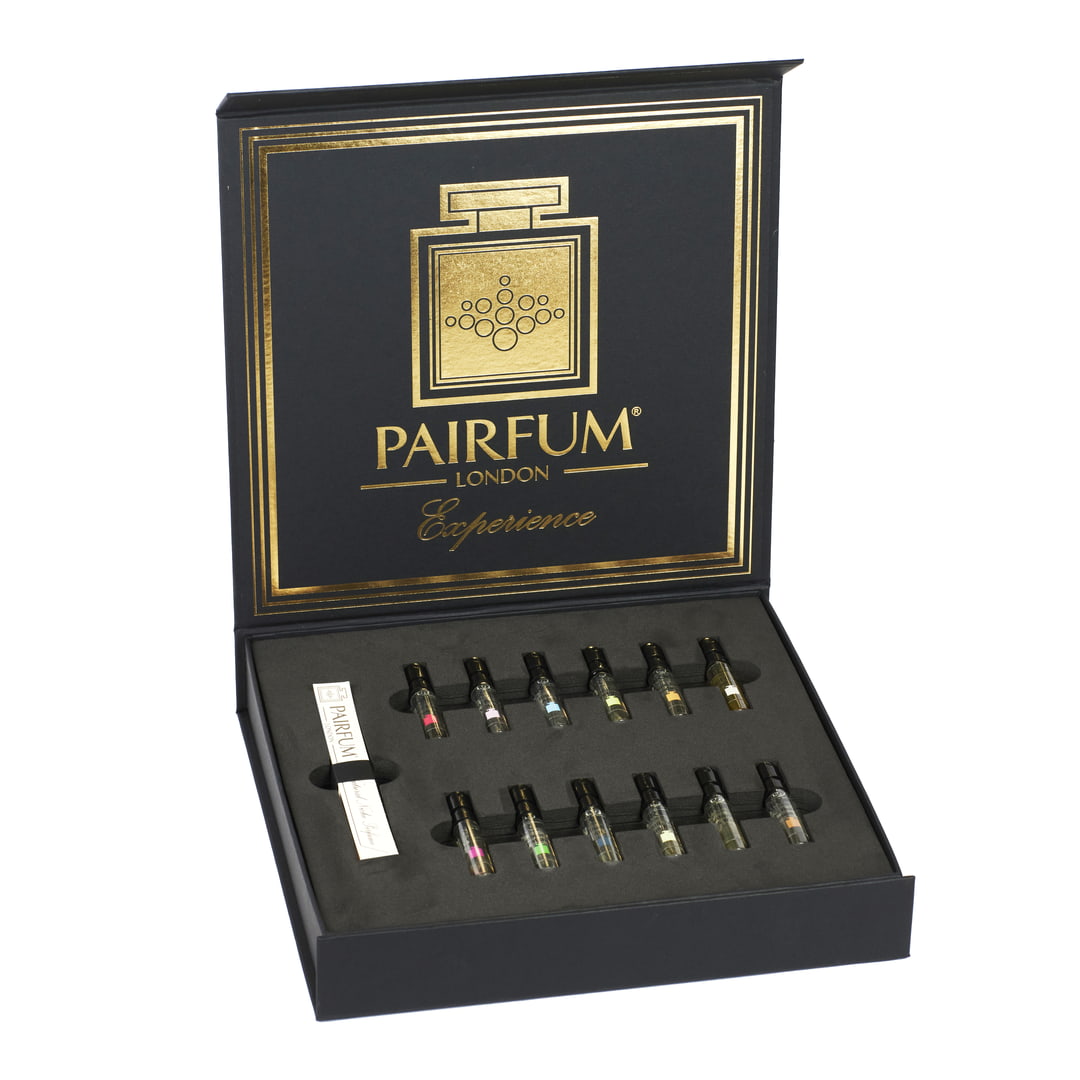
Perfume Experience Box by Pairfum London
Also known as the Fragrance Library, the Perfume Experience Box gathers 12 Eau de Parfum Intense samples in 2 ml glass bottles, together with 50 smelling strips for sampling before wearing. Each bottle gives approximately 100 sprays, enough for daily wear over about two weeks, so you can discover how every scent develops and how long it lasts on your skin, from Bergamot, Basil & Patchouli and Black Cherry & Oolong Tea to Sea Salt, Sage & Amber and Spiced Coffee & Oaked Vanilla. Every perfume is natural and handmade by artisans in the United Kingdom, using natural and organic essential oils with 100% natural, biodegradable alcohol from sugar (molasses), and is vegan and cruelty-free. Fall in love with a fragrance and the price of the box is deducted when you upgrade to the full-sized bottle. A beautiful place to begin, naturally.